A country is not only what it does, but also what it tolerates
As submitted to the Florida Times Union,
published February 18, 2026
By Adam Chaskin, CEO Jewish Community Alliance
Hate rarely begins as hatred. More often, it begins as distance.
When people have little or no experience with those from different backgrounds, races, or religions, they lack a frame of reference. In that vacuum, assumptions rush in. Stereotypes take root. Rumors and half-truths become plausible because there is nothing real to challenge them. It is easy, dangerously easy, to believe what we hear about “them” when we never take the time to know them.
Experience is the great antidote to hate. Sitting across the table from someone who does not look like you, worship like you, or vote like you does something powerful: it replaces abstraction with humanity. It complicates simple narratives. It forces us to see individuals rather than caricatures. Without that exposure, fear fills the gaps, and fear, left unchecked, often hardens into hate.
This is why formal and informal education matters so deeply. And it is why all people, especially those with influence, have a responsibility to educate themselves before making blanket statements about entire groups of people defined by race or religion. Words matter. When spoken publicly, they shape perceptions, legitimize biases, and signal what is acceptable in our national conversation.
I want to be clear about something else: I have tremendous respect for the United States of America and for the constitutional structure that governs this country. I love this nation not because it is perfect, but because it strives, often imperfectly and sometimes painfully, toward its ideals. I respect the office of the President of the United States. That respect, however, does not require agreement.
One of the greatest strengths of living in the United States is the freedom to disagree. In fact, dissent is not a sign of disloyalty; it is a sign of engagement. I can strongly oppose a president’s words or actions without disrespecting the office or the country itself. That distinction is not only possible, but also essential to a functioning democracy.
Which brings me to a tipping point.
The latest statement from President Trump, shared with millions of people, invoked a hateful trope about Black Americans. Regardless of intent, the effect is unmistakable. It does not challenge prejudice; it amplifies it. It does not bring people together; it pushes them further apart. It does exactly the opposite of what a president is supposed to do: help make the United States the greatest country in the world by appealing to our highest values, not our lowest fears.
There is a line often quoted, “With great power comes great responsibility.” While it may have entered popular culture through fiction, its truth is very real. Those in positions of power do not merely reflect society; they shape it. Their words carry weight, travel far, and linger long after they are spoken. With that power comes an obligation to be informed, thoughtful, and careful, especially when speaking about entire communities of people.
Leadership is not just about policy. It is about tone. It is about modeling curiosity instead of contempt, humility instead of certainty, and responsibility instead of recklessness. When leaders fail to educate themselves, or worse, choose to lean into harmful generalizations, they give permission for others to do the same.
Hate thrives when ignorance is given a microphone.
If we are serious about reducing hate in this country, the solution will not come from slogans, viral posts, or outrage cycles. It will come from experience. It will come from education, and it will come from accountability – especially among those whose words reach millions. Hate thrives when ignorance is given a microphone, but it withers when people are willing to listen, learn, and engage with one another as human beings.
That work does not have to begin on a national stage. In fact, it shouldn’t. It starts locally, in our own communities. It starts when we make a conscious effort to reach out to someone from a different background, race, or religion, not to debate with them, but to know them. To ask questions. To listen. To learn their story rather than relying on what we have absorbed through mass media or social media, where outrage is amplified and nuance is lost.
America is at its best when it expands who belongs, not when it narrows the definition. Disagreement can be patriotic. Criticism can be constructive but education, especially among those with the loudest voices, is not optional. It is a responsibility we all share. If we want less hate in our country, we must be willing to replace distance with connection, assumption with experience, and fear with understanding.
With great power, indeed comes great responsibility.
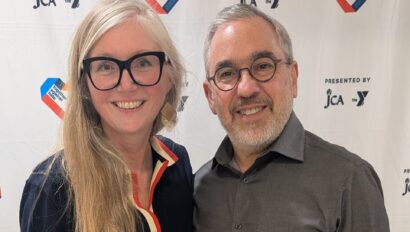
Adam Chaskin is the CEO of the Jewish Community Alliance, the founder of Together Against Hate-a joint project of JCCs and YMCAs across the country, a member of a Jacksonville Black-Jewish Study Circle and is a Jewish American.